
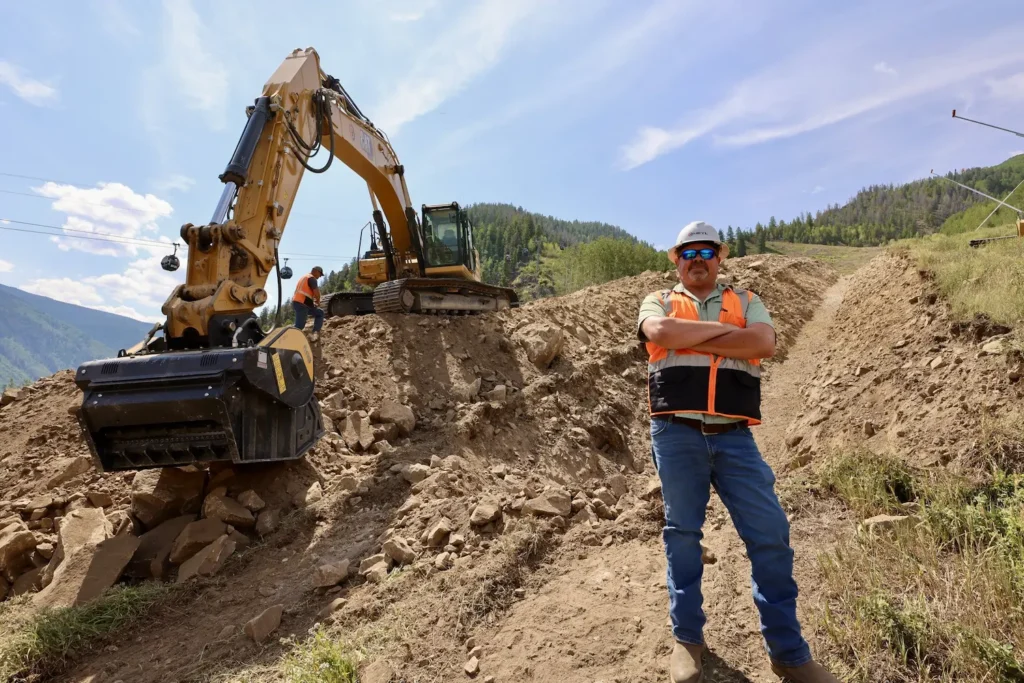
Before the first wall goes up or the first tenant walks through a door, something else has to happen. The land has to be graded, utilities have to be run, and the road has to be built. Plus, water and sewer connections must be installed in the ground, tested, and approved. That work belongs to the civil contractor, and without it, nothing else can start.
If you’re planning a commercial development, a mixed-use project, or any kind of infrastructure work in Colorado’s Roaring Fork Valley, understanding what a civil contractor does and why it matters who you hire will save you time, money, and headaches down the road.
What Is a Civil Contractor?
A civil contractor is a company that plans, executes, and manages construction projects focused on land, infrastructure, and subsurface systems. Where a general contractor builds structures on top of the ground, a civil construction contractor works below it and around it: grading terrain, installing utilities, building roads, and laying the mechanical backbone that every structure depends on.
Civil construction is, at its core, the work that makes development possible. Roads, water mains, sewer lines, gas and electrical conduits, drainage systems, and retaining structures are civil construction deliverables. You rarely see them once a project is complete. But every building, parking lot, and subdivision depends on them completely.
The U.S. infrastructure market was valued at $1.42 trillion in 2025, with federal and state governments projected to allocate approximately $1 trillion toward infrastructure projects, including roads, bridges, and public utility systems. That scale of investment reflects how foundational civil construction work truly is to the broader built environment.
Civil Contractor vs. General Contractor: What’s the Difference?
A general contractor focuses on the structure itself: framing, roofing, interior systems, and finishes. They work above grade, constructing the building that will be occupied or used.
A civil construction contractor works on the site and below it, preparing the conditions that enable the building.
On many large commercial projects, both are needed and often work in parallel. The civil contractor may be installing underground utilities and completing road base work while the general contractor is above-grade on the building shell.
What Does a Civil Construction Contractor Actually Build?
The scope of civil construction work is broader than most people expect. Here is what falls inside it:
Site Work and Excavation
This is where almost every project begins. Site work covers clearing, grubbing, rough grading, cut and fill operations, and final grade preparation. Excavation goes deeper. It prepares the ground for foundations, underground utilities, and subsurface drainage. Without accurate, well-executed site work, everything built on top is compromised.
Road Building
Civil contractors build roads from the subgrade up: subgrade preparation, road base compaction, asphalt preparation and placement, and the curb, gutter, pans, and fillets that manage drainage and define the roadway edge. For development projects that include private drives, access roads, or CDOT frontage improvements, this is the core civil scope.
Water and Sewer Systems
Complete water main and sewer main installation, water and sewer service connections, lift station construction, and tie-ins. These are the utility systems that make a site livable and legally occupiable. They require precise grading for gravity flow, coordination with municipal standards, and experienced operators who understand the terrain.
Shallow Utilities
Natural gas mains and services, electric distribution, telephone, and cable TV infrastructure all fall under shallow utility installation. These systems have to be installed in coordination with each other and with the deep utility work happening at the same time.
Demolition
Civil contractors handle residential and commercial demolition, including the removal of existing asphalt and concrete. Demolition is not just teardown; it is site preparation. The quality of the demo affects everything that comes after it.
Hauling and Material Management
Moving materials to and from a job site, managing cut-and-fill balance, importing road base, and disposing of spoil are logistical functions that a fully equipped civil contractor handles in-house. Control over hauling is control over the schedule.
What Is a Heavy Civil Contractor?
The term “heavy civil contractor” refers to firms that work on the largest-scale infrastructure projects: highways, bridges, dams, tunnels, large-scale utility corridors, and major municipal systems. These projects often involve significant earthmoving, specialized equipment, and coordination with public agencies and transportation departments.
Not every civil construction company operates at the heavy civil scale, but experienced regional contractors with a long project history in complex terrain, CDOT interfaces, and large mixed-use developments occupy a middle ground: commercial and civil work that is technically demanding, schedule-driven, and requires both heavy equipment capability and precision execution.
Why Local Knowledge Matters in Civil Construction
Civil construction does not happen in a vacuum. It happens on specific terrain, in specific weather, under specific regulatory frameworks, and within specific communities. In Colorado’s Roaring Fork Valley, from Silt and Rifle through Glenwood Springs, Carbondale, Basalt, and up to Aspen and Vail, those conditions are distinct.
The valley is experiencing a significant construction surge driven by population growth, housing demand, and aging infrastructure. Proposed developments, transit expansions, and road improvements are creating sustained demand for experienced civil construction contractors who know the terrain, the CDOT requirements, and the local regulatory environment.
Rocky terrain requires different cut-and-fill strategies than flat ground. Proximity to rivers and wetlands creates environmental permitting requirements. Elevation changes affect drainage design. Seasonal construction windows in mountain environments require efficient mobilization and tight schedule management. A civil contractor who has worked in this valley for decades brings knowledge that no amount of project management software can replicate.
Colorado’s construction sector employed approximately 187,500 individuals as of late 2024, and the Colorado Department of Labor and Employment projects the state’s heavy and civil engineering construction sector to grow by 22% between 2020 and 2030. Demand for qualified civil contractors in the region is not slowing down.
How to Choose the Right Civil Construction Company
When you’re evaluating civil contractors for a project, these are the factors that separate a capable firm from a costly gamble:
- Track record of on-budget, on-schedule delivery: Ask for project references and verify them
- Equipment depth: A contractor who owns and maintains their fleet controls their schedule
- Local experience: Familiarity with municipal standards, CDOT interfaces, and regional terrain is irreplaceable
- Estimation accuracy: Detailed, defensible bids protect you from change order surprises
- GPS and survey capability: Machine control technology improves grade accuracy and reduces rework
- Project management systems: Computer-based estimation and job tracking software signals a professionally run operation
The best civil construction contractors do not just build what’s on the plan. They identify problems before they become change orders, communicate proactively with clients, and take ownership of the full scope from mobilization to final inspection.
Civil Construction in the Roaring Fork Valley: What Heyl Builds
Heyl Construction has been working the western slope of Colorado, including the Roaring Fork Valley from Silt through Aspen and Vail, for more than 27 years. Based in Silt, CO, the company handles the full spectrum of commercial and civil construction: complete site work and utility installation, road building, water and sewer systems, shallow utilities, demolition, and project management.
When Geronimo Ventures needed an experienced civil contractor for the Tree Farm PUD, a 42-acre mixed-use development in the Roaring Fork Valley with a water ski lake, extensive infrastructure, and CDOT improvements, Heyl was hired in April 2020 and carried the project through completion. That kind of complex, multi-phase civil scope is exactly what the firm is built for.
Heyl utilizes Trimble and Hemisphere survey and GPS equipment for machine control — the kind of precision technology that reduces rework, accelerates grade work, and keeps projects on schedule. Bids are detailed and accurate. Performance meets or exceeds expectations. That is not a marketing claim; it is a project history.
If you have an upcoming commercial development, site work project, road build, or utility installation in the Roaring Fork Valley, contact Heyl Construction to request a proposal. The earlier a qualified civil contractor is involved in your project, the better the outcome.
Frequently Asked Questions
What is the difference between a civil contractor and a construction contractor?
A civil contractor specializes in land, infrastructure, and subsurface systems: grading, utilities, roads, water, and sewer. A general construction contractor typically builds structures above grade. Many large projects require both working in sequence and in parallel, depending on the phasing.
What is civil construction?
Civil construction refers to projects that build or improve infrastructure and land systems rather than habitable structures. Roads, utility networks, drainage systems, earthworks, and public infrastructure are all civil construction. It is the foundational layer that makes all other development possible.
Do I need a civil contractor for a commercial development?
Almost certainly yes. Any commercial project that requires site grading, utility connections, road access, or parking area construction will need a civil scope. Engaging a civil construction contractor early, ideally during design, helps identify underground conflicts, utility routing issues, and sequencing challenges before they become expensive change orders.
How do I know if a civil contractor is qualified for my project?
Look for a verifiable project history in your region, owned and maintained equipment, local knowledge of municipal and CDOT standards, and a track record of on-budget, on-schedule delivery. Ask for references on comparable projects and follow up on them. A reputable civil construction company will welcome that scrutiny.
What geographic area does Heyl Construction serve?
Heyl Construction serves the western slope of Colorado, with deep experience throughout the Roaring Fork Valley, including Silt, Rifle, Glenwood Springs, Carbondale, Basalt, El Jebel, Aspen, and the Vail Valley. The company is based in Silt, CO, and has operated in the region for over 27 years.
The Ground Work Starts Here
Every project that gets built in Colorado’s Roaring Fork Valley starts with civil work. The grading, utilities, roads, and drainage systems that nobody sees are the reason everything else stands up, drains correctly, and connects to the grid.
Choosing the right civil contractor for your project is not a procurement decision — it is a risk management decision. The firm you hire determines whether your project breaks ground on time, whether your bids are accurate, and whether the infrastructure beneath your building performs the way it should for the next 50 years.
Ready to get your project started right?
Heyl Construction has handled civil construction projects throughout the Roaring Fork Valley for over 27 years. Request a proposal today and find out why developers across western Colorado trust Heyl to deliver.